A while ago, I wrote a post reviewing the Pura-Fit 6800 (US version) and SparkPlugs 6604 (US version). In particular, the Pura-Fit 6800 have been one of my favorite foam earplugs for many years.
In that review post for the US versions, I also noted that Moldex SparkPlugs were large earplugs. To my surprise, some readers sent me feedback that they felt SparkPlugs were a bit on the small side.
Well, I now may have the answer as to why they felt that way:
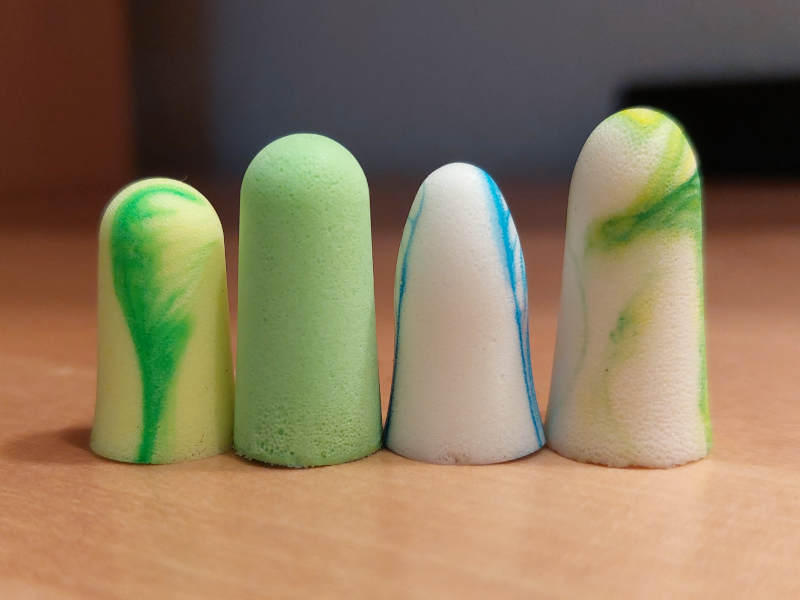
During a recent trip, I picked up some European Moldex earplugs, including the Pura-Fit 7700 and the Spark Plugs 7800. It turns out that both European models are substantially smaller than their US namesakes:
From left to right: Pura-Fit 7700, Pura-Fit 6800, Spark Plugs 7800, SparkPlugs 6604
To keep things clear in this review, I’ll refer to them as:
Pura-Fit Europe (Model 7700) vs Pura-Fit US (Model 6800)
Spark Plugs Europe (Model 7800) vs SparkPlugs US (Model 6604)
(Yep, in Europe they are spelled with a space.)
The PU foam formula/consistency of the US and the European variants appears to be the same (or very similar). Moldex’s PU formula works well for me for both comfort and noise reduction.
But, as expected, because of their different sizes, these earplugs feel and behave quite differently in my ear.
Important note: The testing methodologies and rating systems in Europe and the US are different, so the numbers can’t be directly compared. The European versions both have an SNR of 35, but they don’t have an NRR (US rating). The US versions both have an NRR of 33, but they don’t have an SNR.
If you need hearing protection, make sure to use earplugs that have the correct rating for your region! If you are looking for annoyance reduction (e.g., earplugs for sleeping), you have more flexibility.
Contents
My experience and assessment
I have now used both European models for quite a while and find them to be comfortable and effective foam earplugs.
I can use both for a whole night without any discomfort.
Moldex’s PU foam composition makes them easy to roll up and they stay compressed long enough for me to insert them without issues.
I think they are a great option for many of my European readers, in particular for side sleeping due to their comparatively shorter length.
Among the two European earplugs, Pura-Fit 7700 are my favorites, but Spark Plugs 7800 ain’t bad either. I find both comfortable for sleeping. Pura-Fit are a tad more comfy, longer-lasting, and in my ears they are somewhat more effective at reducing noise.
For reducing nighttime noise, they would in principle also be a a good option for US users with average and somewhat smaller ears, but they are a bit hard to find in the US (you would probably have to order them from Europe, e.g., via Amazon UK).
How do they compare to the American Moldex versions in my ear?
I have used Pura-Fit US (review) for many years and they remain one of my favorite earplugs.
In my ears (!), they outperform the shorter European earplugs in terms of noise reduction by quite a bit (see below for details).
SparkPlugs US have always been a tad too long and large for me. But, their foam is good too, so if you have very large ears…
Noise reduction performance details
Note: The data and discussion below refer to my experience using these earplugs against everyday noise. This section is not meant to evaluate performance as a hearing protector. For hearing protection, please refer to the published noise reduction data and ratings relevant to your country.
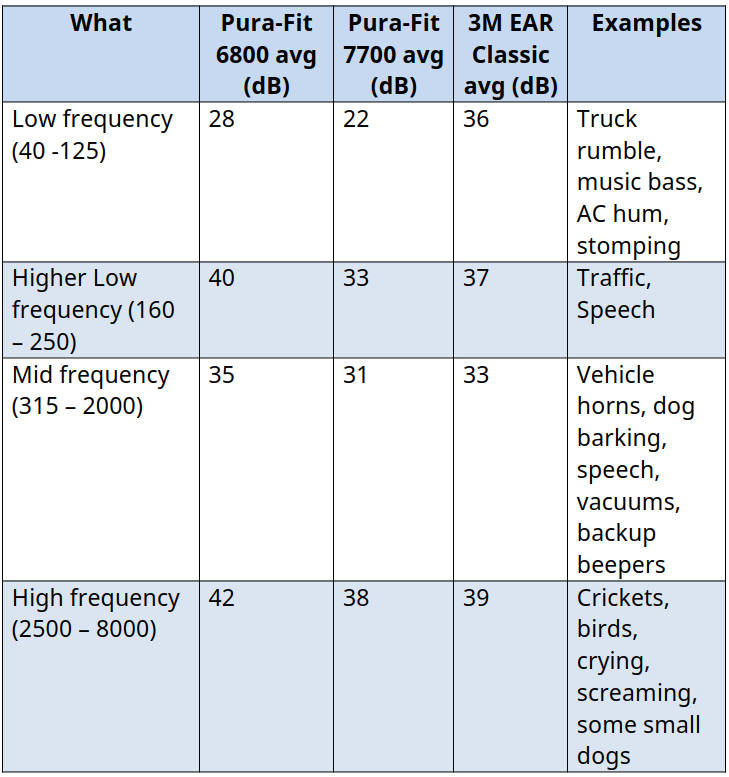
The table shows my noise reduction averages (arithmetic) obtained from tests using pulsed noises (1/3rd octave steps):
Both Pura-Fit models are are good at reducing most noises you would encounter during sleep.
As you can see, the US Pura-Fit 6800 perform quite a bit better than the European 7700 in my ears, provided I fully insert them.
If I roll them into a nail shape, i.e., leaving the wider end uncompressed to control the insertion depth (as a person with a shorter ear canal might do), the noise reduction performance of the 6800 and 7700 is similar.
Subjectively, the European Spark Plugs performed similarly to the European Pura-Fit, perhaps a tad worse. I have used them quite a bit as well at night and like them. Overall I prefer Pura-Fit, so I focused on those for more detailed tests. But, if they became unavailable, the European Spark Plugs would be a solid alternative.
How about low frequency noise?
While the US versions perform better against low-frequency noise (LFN) – truck rumble, HVAC systems that emit a LFN hum, generators, footfalls, etc. – none of the earplugs discussed here come close to the 3M EAR Classic for reducing LFN.
For more information and test results, read the post on my favorite earplugs against low frequency noise.
So for general noise reduction, I am happy to use the Moldex; when my focus is low frequency noise reduction, it’s EAR Classic every time.
The advantage of the Moldex PU plugs compared to PVC plugs like the Classic is that they are more durable while being as comfortable in my ears. Also, I believe alternating between different earplugs is better than just relying on a single model to avoid pressure points.
European Pura-Fit and Spark Plugs vs other earplugs for smaller ears
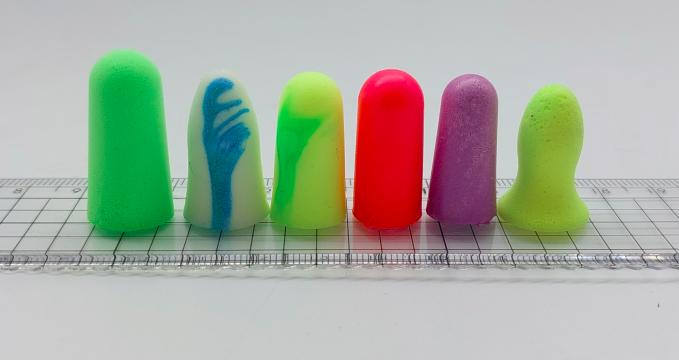
From left to right: Pura-Fit 6800 (not small), SparkPlugs 7800, Pura-Fit 7700, Pretty in Pink, Mack’s SlimFit, Meteors small.
I have ordered the earplugs from largest to smallest, with the right-most being the smallest.
Both Pura-Fit 7700 and SparkPlugs 7800 are about the same length as Hearos Pretty in Pink (PiP, one of my recommended earplugs for smaller ears) but a bit thicker. SlimFit are clearly slimmer.
I find the European Pura-Fit to be a tad more comfortable for long-time wearing than PiP. If available where you live, I’d try Pura-Fit first.
As mentioned earlier, I like the foam composition of the Moldex earplugs described in this post. I prefer it over the foam of PiP or Mack’s SlimFit. Moldex earplugs are less sticky.
The smallest in the image are Moldex Meteors small, which in the US are also distributed by Flents as Flents Protechs Sleep Earplugs. They are the smallest of them all.
The European Pura-Fit 7700 (SNR 35) and Spark Plugs 7800 (SNR 35) are very good options for people with smaller and normal-sized ears and I recommend them.
They appear to have the same foam composition as their American counterparts. I find them them easy to insert and comfortable. Among the two, I slightly prefer Pura-Fit.
Both European versions work well for me but are a bit on the short/small side and hence leave some noise reduction potential on the table.
I think it boils down to the size of your ear canal which ones are the better fit for you.
Unfortunately, for hearing protection, the smaller Eurpean models are not rated for the US market and the American ones not for the European market. Ideally Moldex would offer both sizes in both markets (with ratings for both), so consumers could choose based on their ear size rather than their location.
As you can see from the noise reduction results in my ears, one size doesn’t fit all equally well.
Perhaps the smaller European versions wouldn’t achieve as high a noise reduction rating (NRR) as their American counterparts:
The currently published US NRR is an average based on an expert inserting the earplugs into 10 subjects’ ears. The expert may well be able to insert the larger earplug even into smaller ears and optimize noise reduction.
But that doesn’t mean that fully-inserted larger earplugs remain comfortable for folks with smaller ears or that the subjects themselves can achieve the same expert-optimized insertion. You’ll find plenty of reports by people who complain about a highly-rated earplug being too big.
On the other hand, people with longer or larger ear canals may leave noise reduction potential on the table by having to choose the shorter/smaller earplugs available in their region.